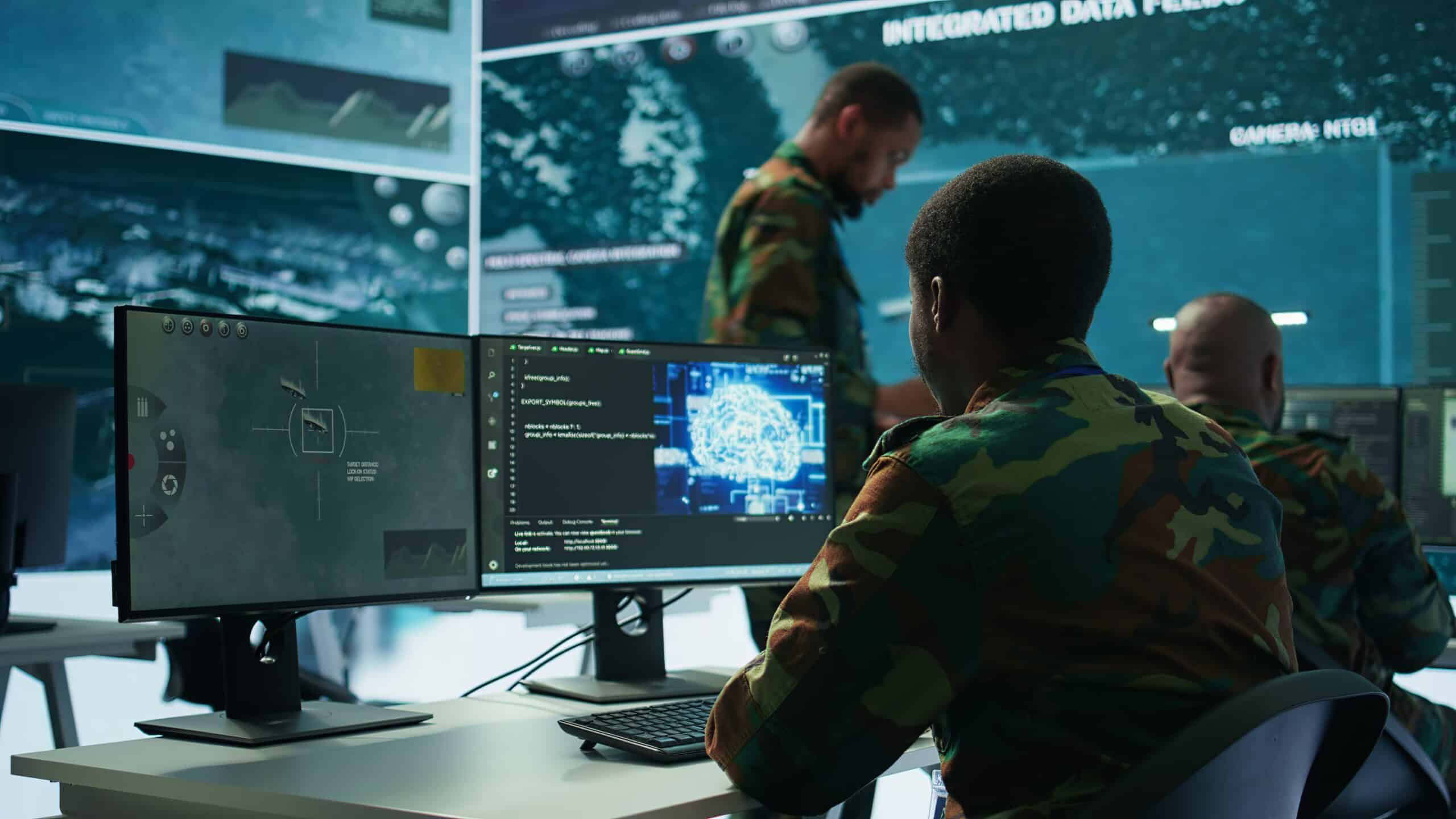

Robotics and AI automation represent one of the most computationally demanding frontiers in federal technology investment. Whether the application is autonomous ground vehicle navigation, drone swarm coordination, manufacturing automation in defense production, or AI-directed experimentation in national laboratories, the hardware requirements for these workloads push beyond what general-purpose computing can support.
The federal investment in this space is accelerating. The Pentagon has requested $29.5 billion in FY2027 funding to modernize AI supercomputing capabilities and expand secure computing infrastructure through its AI Arsenal initiative. The Genesis Mission, launched by executive order in November 2025, directs the Department of Energy to link the supercomputers, AI systems, and scientific data across all 17 national laboratories into a single unified platform, with robotic laboratory and production facilities explicitly named as a priority capability by July 2026. The FY2026 National Defense Authorization Act authorizes the acceleration of autonomy-enabling software across defense programs and establishes emerging technology cooperation programs in AI, robotics, and automation with allied nations.
For federal program managers, defense contractors, and research institutions working in this space, the hardware question is not whether to invest in HPC infrastructure for robotics and AI automation. It is which configuration matches the specific demands of the workload, and how to procure it through a compliant federal pathway.

Robotics and AI automation workloads are not uniform, but they share a common characteristic that distinguishes them from standard enterprise computing: they require the simultaneous execution of multiple computationally intensive processes, each with real-time or near-real-time performance requirements that do not tolerate the latency and throughput limitations of general-purpose hardware.
A robotic system performing autonomous navigation must simultaneously process sensor inputs from multiple sources, run perception models that identify and classify objects in the environment, execute path planning algorithms that compute optimal routes in real time, and interface with control systems that translate computational outputs into physical actions. Each of these processes is demanding in isolation. Running them concurrently, at the speeds required for real-world operation, demands hardware that was designed for exactly this kind of parallel, sustained compute workload.
AI automation workflows add additional layers of compute demand. Training the models that underpin autonomous behavior requires sustained GPU throughput across extended training runs. Reinforcement learning, which is the training methodology most commonly used for robotics applications, involves running simulations of the robotic environment thousands or millions of times to teach the system optimal behavior through trial and error. The simulation environment itself is computationally intensive, and the reinforcement learning loop requires the ability to run many simulation instances simultaneously to accelerate the training process.
Simulation and Reinforcement Learning
Reinforcement learning for robotics is one of the most GPU-intensive workloads in the federal AI space. Training a robotic system to navigate complex environments, manipulate objects, or coordinate with other autonomous systems requires running physics-based simulation environments at high speed while simultaneously training neural network models on the simulation data.
The hardware requirements for reinforcement learning training are driven by the need to run many parallel simulation instances, which requires high GPU core count and memory bandwidth, large system memory to hold the simulation state across multiple concurrent instances, and fast NVMe storage to manage the checkpointing and data logging that extended training runs require.
ECC memory ensures the integrity of training data across long training runs where a single uncorrected error can corrupt days of computation
Perception and Computer Vision
Robotic systems deployed in federal and defense environments, from autonomous ground vehicles to drone surveillance platforms, depend on computer vision and sensor fusion models that must process high-resolution sensor data in real time. These perception models run continuously during operation and require GPU configurations optimized for inference throughput rather than training performance.
For federal programs where the robotic system must operate in contested or denied environments without cloud connectivity, on-board or dockside edge computing infrastructure must provide the full inference capability independently. This drives demand for power-efficient GPU configurations that can deliver the required inference throughput within the power and thermal constraints of the deployment platform
Digital Twin Development and Validation
Digital twins, high-fidelity virtual models of physical robotic systems and their operating environments, are increasingly central to federal defense and research robotics programs. A digital twin allows engineers to simulate, test, and validate robotic behavior before deploying physical systems, reducing development time and cost while improving safety.
Building and running a digital twin at research-grade fidelity requires the same GPU compute, memory, and storage capabilities as the physical system simulation it models, plus the visualization capabilities to render the twin environment for engineering review. For programs developing autonomous systems for complex environments, digital twin workloads are among the most demanding compute applications in the development pipeline.
Multi-Agent Coordination and Swarm Simulation
Federal defense programs involving drone swarms, autonomous ground vehicle formations, or multi-robot logistics operations require simulation environments that can model the behavior of many autonomous agents simultaneously. Swarm simulation is multiplicatively demanding relative to single-agent simulation: each additional agent adds compute, memory, and communication overhead to the simulation environment.
Multi-agent coordination workloads benefit particularly from high-memory-bandwidth GPU architectures and large system memory configurations that can hold the full simulation state of many agents without requiring frequent memory transfers that introduce latency and reduce simulation throughput.
Workload | GPU Priority | Memory Floor | Storage | Recommended Tier |
Reinforcement Learning Training | Parallel compute, high VRAM | 128GB ECC DDR5+ | High-speed NVMe, large capacity | Multi-GPU workstation or server |
Perception and Inference | Throughput, power efficiency | 64GB ECC DDR5+ | Fast NVMe for model loading | Single or dual GPU workstation |
Digital Twin Development | Compute and visualization | 256GB ECC DDR5+ | High-capacity NVMe | High-memory multi-GPU workstation |
Swarm Simulation | Memory bandwidth, parallel compute | 256GB ECC DDR5+ | High-throughput NVMe | Multi-GPU server or cluster node |
Real-Time Control and Planning | Low-latency inference | 64GB ECC DDR5+ | Fast NVMe boot and model storage | Power-optimized GPU workstation |

Federal programs investing in robotics and AI automation infrastructure must navigate the same procurement compliance requirements that apply to all federal HPC hardware acquisitions, with some additional considerations specific to autonomous systems and defense applications.
Hardware deployed in federal robotics programs, particularly those with defense or national security applications, is subject to TAA compliance requirements and may face additional supply chain security scrutiny. Autonomous systems that rely on computing infrastructure with components from non-designated countries introduce supply chain risks that go beyond procurement compliance, affecting the integrity and trustworthiness of the systems those platforms support.
Ace Computers manufactures and integrates all systems at our ISO 9001-compliant facility in Des Plaines, Illinois, with full TAA compliance documentation available for all products. For programs with elevated supply chain security requirements, our U.S.-based manufacturing and component sourcing transparency provide the documentation foundation that security reviews require.
NIST SP 800-223, published in 2024, establishes the first zone-based reference architecture specifically designed for HPC environments, defining four functional zones with distinct security requirements that reflect how HPC systems actually operate. NIST SP 800-234, expected to be finalized sometime in 2026, provides a practical security control overlay drawn from SP 800-53 tailored to HPC operational contexts.
Federal programs operating HPC infrastructure for robotics and AI automation should evaluate their hardware configurations and operational practices against these emerging NIST standards. Programs that align their infrastructure with SP 800-223 and 800-234 from the start will be better positioned for compliance reviews as these standards move from guidance to requirement across federal HPC programs.
Federal agencies and defense contractors procuring HPC workstations and servers for robotics and AI automation programs can access Ace Computers systems through established contract vehicles:
Ace Computers has been delivering HPC infrastructure to federal agencies, defense organizations, and research institutions for more than 40 years. Our engineering team works directly with program managers and technical leads to evaluate the specific workload requirements of robotics and AI automation programs before recommending a configuration, ensuring that the hardware delivered matches the actual demands of the mission rather than the nearest standard catalog option.
For reinforcement learning training, we configure multi-GPU workstations with the VRAM capacity, memory bandwidth, and parallel compute that training throughput demands. For perception and inference at the edge, we engineer power-optimized configurations that deliver the required inference performance within deployment constraints. For digital twin and swarm simulation, we provide the high-memory, high-throughput platforms that complex simulation environments require.
Every Ace Computers system for a federal program ships with TAA compliance documentation, is available through established federal contract vehicles, and is backed by our full lifecycle support commitment from deployment through end-of-life planning.
→ View Ace Computers AI and HPC Solutions
HPC workstations for robotics are configured for sustained parallel compute operation at or near peak load for extended periods, with ECC memory that protects training data integrity and GPU architectures optimized for the specific workload type. Standard workstations are designed for productivity workloads with occasional compute peaks. Reinforcement learning training, physics simulation, and multi-agent coordination all require the sustained throughput that HPC-class hardware provides.
Yes. Our engineering team conducts workload assessments that evaluate the specific compute requirements, simulation environment characteristics, and deployment constraints of each program before recommending a configuration. Contact our federal sales team to begin a workload assessment for your robotics or AI automation program.
Yes. Ace Computers holds active contracts under ITES-4H, ADMC 3, 2GIT, NASA SEWP V, and GSA Schedule. Defense programs can procure HPC workstations and servers for robotics and AI automation applications through any of these vehicles with full TAA compliance documentation.