
Digital evidence is now present in nearly every criminal investigation. Smartphones, laptops, cloud accounts, surveillance footage, and IoT devices all generate data that forensic examiners must acquire, preserve, and analyze in ways that will hold up in court. The volume and complexity of that evidence has grown faster than the hardware in most law enforcement forensic labs has kept pace with.
The result is a growing backlog problem. Agencies that are processing digital evidence on underpowered or outdated hardware are not just working slowly. They are creating bottlenecks that delay prosecutions, strain examiner capacity, and in some cases force investigators to prioritize only the most urgent cases while others wait. The right hardware does not just make forensic work faster. It makes it sustainable.
This guide covers the hardware requirements for a modern law enforcement digital forensics lab in 2026, from workstation processor and memory specifications through storage, GPU acceleration, and federal procurement pathways for agencies buying through established contract vehicles.

The most common hardware mistake law enforcement agencies make is procuring standard commercial workstations and attempting to use them for forensic work. The specs may look adequate on a product sheet. The performance under actual forensic workloads tells a different story.
Forensic workstations operate under sustained, parallel compute loads that standard commercial systems are not designed to handle continuously. Disk imaging runs for hours while simultaneously hashing the acquired data. File carving and timeline analysis process millions of artifacts in parallel. Password and encryption recovery runs GPU-accelerated brute force operations that push compute hardware to its limits for extended periods. These are not the workloads that drive commercial workstation design. They are the workloads that define forensic workstation requirements.
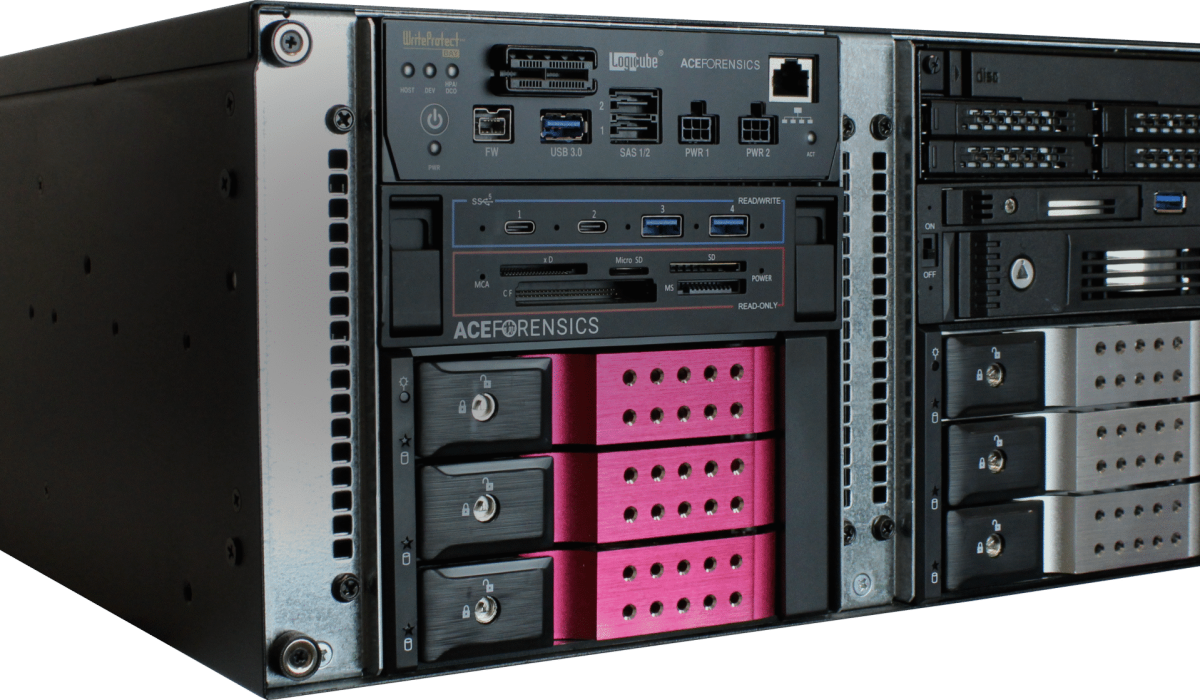
Beyond performance, forensic workstations require hardware features that commercial systems do not prioritize: write blocker integration or compatibility, ECC memory to protect evidence integrity during long processing runs, storage configurations that separate evidence acquisition from analysis, and the thermal management to sustain peak compute loads across multi-hour examination sessions without throttling.
Agencies that attempt to force commercial hardware into forensic workflows consistently encounter the same problems: longer imaging times, analysis bottlenecks, hardware failures under sustained load, and in some cases evidentiary integrity questions that arise from using hardware not purpose-built for forensic workflows.
The processor is the most consequential hardware decision in a forensic workstation, and the decision framework is more nuanced than simply buying the fastest available chip.
Cores vs. Clock Speed
Digital forensic workloads fall into two categories with different processor requirements. Highly parallel workloads, including file carving, multi-image analysis, artifact processing, and timeline reconstruction, benefit primarily from core count. More cores allow the forensic software to distribute work across parallel threads, reducing total processing time proportionally as core count increases.
Single-threaded workloads, including certain legacy forensic tools and sequential operations that cannot be parallelized, benefit primarily from clock speed. A processor with fewer cores but higher clock speed will outperform a high-core-count processor on these specific tasks.
In most law enforcement forensic labs, the workload mix favors high core count. Modern forensic software is increasingly optimized for parallel processing, and the dominant time-consuming workloads, imaging, hashing, file carving, and artifact analysis, all benefit from maximum thread availability. High-core-count processors from AMD’s EPYC and Threadripper PRO product lines and Intel’s Ultra product lines are well-suited to law enforcement forensic workstation requirements, with Ace Forensics engineering custom configurations from these platforms based on the specific workflow requirements of each agency.
Memory Architecture
The processor’s memory architecture matters as much as core count for forensic workloads that require loading large evidence datasets into memory for analysis. Memory bandwidth, the rate at which data can move between memory and the processor, determines how quickly forensic tools can access the evidence data they are processing. Processors with high-bandwidth memory architectures complete memory-intensive forensic operations faster regardless of clock speed or core count.
For agencies processing large multi-device cases with evidence sets in the hundreds of gigabytes or terabytes, memory bandwidth is often the actual bottleneck that limits processing speed, not processor compute capacity. Selecting a processor platform with high memory bandwidth is as important as selecting one with adequate core count.
RAM requirements for forensic workstations are driven by three factors: the size of the evidence datasets being analyzed, the number of concurrent analysis processes running simultaneously, and the forensic software tools in use and their specific memory requirements.
ECC, or Error-Correcting Code memory, is the standard for forensic workstations because it detects and corrects single-bit memory errors before they can affect data integrity. In a forensic context, a bit-flip error in standard non-ECC memory during evidence processing could theoretically alter the data being analyzed, creating an evidentiary integrity question that no agency wants to face in court.
ECC memory eliminates this risk by correcting single-bit errors in real time without impacting performance. For law enforcement forensic work where chain of custody and evidence integrity are foundational requirements, ECC memory is not optional. It is a standard requirement for any purpose-built forensic workstation.
The minimum RAM for a current forensic workstation handling modern caseloads is 64GB of ECC DDR5. This provides adequate headroom for multi-tool analysis environments, virtualization for malware examination, and concurrent processing of multiple evidence sources. For agencies running high-volume labs or processing large enterprise forensic cases, 128GB or 256GB configurations provide the additional headroom that eliminates memory as a processing bottleneck.
RAM is one of the most cost-effective performance upgrades available for forensic workstations. The processing time reduction from moving from 32GB to 128GB on memory-intensive forensic workloads consistently exceeds what a processor upgrade alone can deliver.
Storage in a forensic workstation serves three distinct functions that have different requirements: the operating system and forensic software environment, active evidence acquisition and processing, and long-term evidence archival. Optimizing storage for forensic workflows means addressing all three separately rather than using a single storage pool for everything.
The OS and application drive should be a fast NVMe SSD with sufficient capacity for the operating system, forensic software suite, and working files. High read and write speeds on this drive reduce application launch times and tool loading speeds throughout the examination day. A separate OS drive also allows the forensic environment to be restored quickly from a known-good image if the workstation requires re-imaging between cases, which is a standard anti-contamination practice in professional forensic labs.
Evidence acquisition and active case processing require high-throughput storage that can sustain the read and write speeds that imaging and analysis tools demand. Enterprise-grade NVMe SSDs provide the throughput that modern forensic workflows require, with sequential read and write speeds that allow imaging to proceed at the speed of the acquisition hardware rather than the speed of the storage destination.
RAID configurations, where multiple drives are combined for redundancy and performance, are appropriate for evidence storage in agencies where case volume and evidence dataset sizes exceed what a single drive can accommodate. RAID 10, which mirrors data across paired drives for redundancy while striping for performance, is the configuration most commonly used in law enforcement forensic labs because it provides both data protection and the throughput that large evidence sets require.
Long-term evidence storage for completed cases requires high-capacity solutions that prioritize reliability and data integrity over raw speed. Network-attached storage with RAID redundancy provides the capacity, accessibility, and data protection that long-term forensic evidence archival requires, with the ability to expand storage capacity as case volume grows without replacing the primary workstation.
GPU acceleration has moved from an optional enhancement to a meaningful performance factor in modern forensic workloads. Two specific application categories drive the majority of GPU utilization in law enforcement digital forensics.
GPU-accelerated password recovery is the most well-established forensic application of GPU compute. Tools like Passware Kit and Hashcat leverage the massively parallel architecture of modern GPUs to attempt password combinations at rates that CPU-only processing cannot approach. For investigators working with encrypted devices or files, the difference between a GPU-accelerated and CPU-only recovery workflow can be measured in days or weeks of examination time.
VRAM capacity is the key variable in GPU selection for password recovery workloads. The size of the dataset the GPU can process simultaneously is limited by available VRAM. Ace Forensics uses NVIDIA RTX series GPUs across forensic workstation configurations, providing the VRAM capacity and compute architecture that GPU-accelerated forensic tools require.
AI-assisted triage tools that automatically categorize images, flag relevant content, and identify known illegal material use GPU acceleration to process large evidence datasets at speeds that manual review cannot match. As AI triage tools become standard in law enforcement forensic workflows, GPU capacity becomes a standard forensic workstation requirement rather than a specialized enhancement.
Workload | CPU Priority | RAM Floor | Storage | GPU |
Disk Imaging and Hashing | I/O throughput, clock speed | 64GB ECC DDR5 | Fast NVMe, high throughput | Not required |
File Carving and Timeline Analysis | Core count, cache | 128GB ECC DDR5 | Fast NVMe, large capacity | Not required |
Password and Encryption Recovery | Core count | 64GB ECC DDR5 | Standard NVMe | High VRAM GPU required |
AI-Assisted Evidence Triage | Core count | 128GB ECC DDR5 | High-capacity NVMe | High VRAM GPU required |
Mobile Device Forensics | Clock speed, I/O | 64GB ECC DDR5 | Fast NVMe | Not required |
Multi-Case Concurrent Processing | High core count | 256GB ECC DDR5 | RAID NVMe array | Optional acceleration |
Law enforcement agencies at the federal, state, and local level face a procurement challenge that goes beyond hardware specifications. Agencies that are constrained to purchasing from established IT procurement lists maintained by their parent organization frequently find that the workstations available on those lists are commercial systems that do not meet forensic workload requirements.
As one Ace Forensics Digital Forensic and AI Solutions Engineer noted after 31 years in law enforcement, agencies across the country are being forced to buy computers off their agencies established procurement lists and are not permitted to purchase purpose-built forensic systems from forensic hardware companies. The result is that investigators receive commercial workstations with inadequate GPU configurations, insufficient storage, and no forensic-specific hardware, at prices that exceed what a purpose-built forensic system would cost.
Federal law enforcement agencies and federally funded state and local agencies can access Ace Forensics systems through established federal contract vehicles that have completed compliance vetting:
Ace Forensics provides a five-year warranty on all digital forensics computer systems, reflecting our confidence in the durability of purpose-built forensic hardware under the sustained workloads of active law enforcement use. The FORCE series of digital forensics workstations starts at $7,500, significantly below the cost of comparable commercial systems that still require additional forensic hardware and storage to be functional for law enforcement use.
→ View Ace Forensics Solutions
The practical minimum for current forensic caseloads is 64GB of ECC DDR5. Agencies running high-volume labs, processing large enterprise forensic cases, or running multiple concurrent examination environments should configure for 128GB or 256GB. ECC memory is required for forensic work to protect evidence integrity during long processing runs.
Not all forensic workflows require a high-end GPU, but agencies that need to recover passwords from encrypted devices or run AI-assisted evidence triage tools will see significant performance improvements from GPU acceleration. NVIDIA RTX series GPUs with adequate VRAM are the standard recommendation for forensic workstations that include these workflows.
Yes. Ace Forensics systems are available through GSA Schedule and four additional federal contract vehicles including NASA SEWP V, ITES-4H, ADMC 3, and 2GIT. State and local law enforcement agencies with federally funded programs may also be eligible to purchase through GSA Schedule under the Cooperative Purchasing program.
Standard commercial workstations are designed for productivity workloads where a rare, uncorrected memory error produces a software crash or display artifact that is easily identified and has no lasting consequence. Forensic workstations process evidence data where an uncorrected memory error could theoretically alter the data being analyzed, creating an evidentiary integrity question. ECC memory eliminates this risk by detecting and correcting single-bit errors in real time, maintaining the integrity of evidence data throughout the examination process.