Home/Forensics Blog/Forensic Lab Budget Planning: A Practical Guide for Law Enforcement Agencies
Forensic Lab Budget Planning: A Practical Guide for Law Enforcement Agencies
Building or upgrading a digital forensics lab is a capital planning exercise as much as it is a technical one. Forensic lab administrators are frequently the people best positioned to understand what hardware the lab needs, but the least positioned within their agency to translate that need into a budget request that survives review by finance, command staff, or a city council appropriations committee.
This guide covers how to think about forensic lab budgeting practically: what actually drives cost, how to structure a capital request that gets approved, how to plan for the multi-year refresh cycle that forensic hardware requires, and how to make the case for purpose-built hardware when the easier, cheaper-looking path is buying from a standard commercial IT vendor list.
Standard IT budget planning treats computing hardware as a depreciating commodity: buy the cheapest system that meets minimum specifications, replace it on a standard refresh cycle, and treat any additional spending as unnecessary. That framework does not work for forensic labs, and agencies that apply it consistently end up spending more over the life of the equipment while getting worse investigative outcomes.
The reason is straightforward. Underpowered forensic hardware does not just run slower. It extends case processing times, which extends investigation timelines, which delays prosecutions and increases the backlog of unprocessed evidence. The cost of underspecified forensic hardware is not just the hardware itself. It is measured in case backlog, examiner overtime, and in some cases cases that cannot be brought to prosecution before statutory deadlines.
What Drives Forensic Lab Costs
Workstation Hardware
The forensic workstation itself is typically the largest single line item, and the price range is wide depending on configuration. A properly specified forensic workstation for a small to mid-size agency typically starts around $7,500 to $10,000 for a single-examiner configuration, with high-end multi-GPU configurations for labs running heavy password recovery or AI-assisted triage workloads running $15,000 to $20,000 or more.
Forensic-Specific Hardware
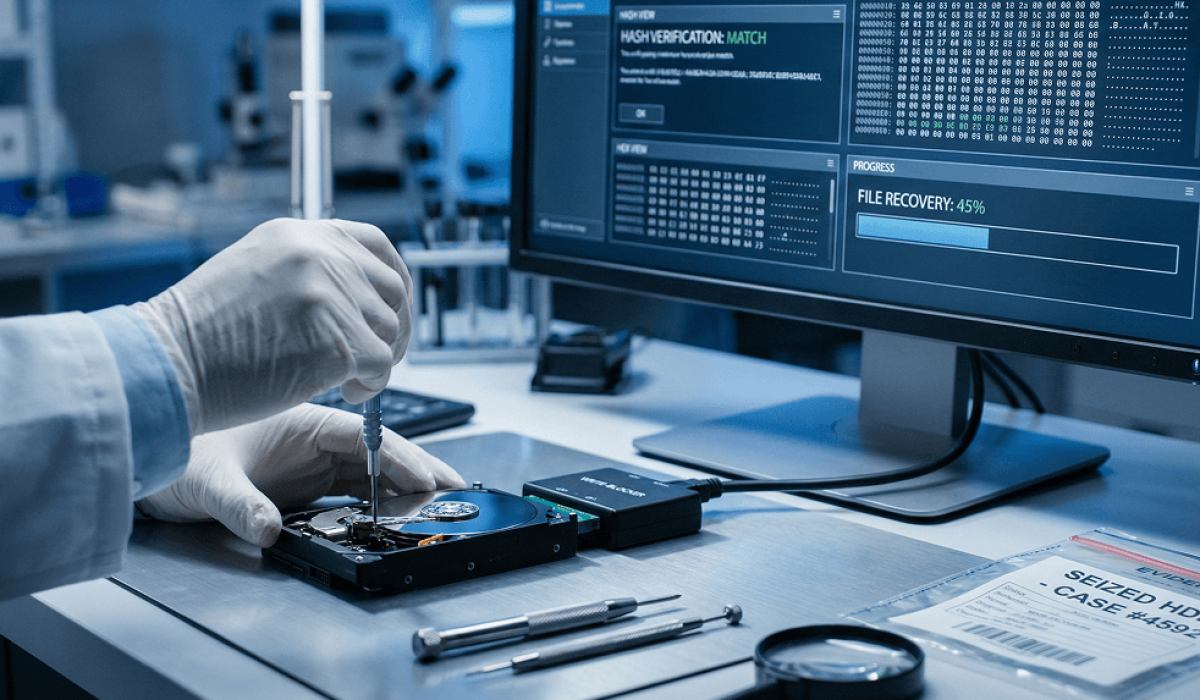
Write blockers, disk duplicators, forensic card readers, and mobile device acquisition hardware are additional line items that a standard commercial workstation quote will not include. Agencies that budget only for the workstation and discover the need for this additional hardware after the capital request has already been approved frequently find themselves without the funding to complete the lab setup.
Storage Infrastructure
Long-term evidence storage, particularly for agencies handling large-scale digital evidence including video, mobile device extractions, and multi-terabyte cases, requires storage infrastructure beyond what a single workstation includes. Network-attached storage with RAID redundancy is a separate budget line that scales with case volume and evidence retention requirements.
Software Licensing
Forensic analysis software licenses, including tools for imaging, file carving, mobile device extraction, and password recovery, carry ongoing annual licensing costs that should be budgeted as a recurring operational expense, not a one-time capital cost.
Training and Certification
Examiner training and certification maintenance is an ongoing cost that is easy to underbudget. New hardware and software capabilities require examiner training to use effectively, and forensic certifications typically require continuing education to maintain.
Building a Defensible Capital Request
A capital request for forensic hardware that gets approved on the first submission typically does three things that a request built around vendor quotes alone does not: it connects the hardware need to case outcomes, it demonstrates the cost of the status quo, and it compares total cost of ownership rather than just purchase price.
Connect Hardware to Case Outcomes
Command staff and budget reviewers respond to operational impact, not technical specifications. Rather than requesting funding for a workstation with specific processor and memory specifications, frame the request around what the current hardware limitation is costing the agency: case backlog measured in days or cases, examiner overtime required to work around hardware limitations, or specific case types the agency currently cannot process in-house and must outsource.
Demonstrate the Cost of the Status Quo
If current hardware is producing a documented backlog, quantify it. Number of cases waiting for processing, average wait time from evidence receipt to examination completion, and any instances where case timelines affected prosecution outcomes are concrete data points that make the cost of inaction visible to budget reviewers who are not forensic examiners themselves.
Compare Total Cost of Ownership, Not Just Purchase Price
A lower-priced commercial workstation that requires additional forensic hardware purchases, runs slower on forensic workloads extending case processing time, and carries a shorter warranty requiring earlier replacement frequently costs more over a five-year period than a purpose-built forensic system with a higher initial price. Building this comparison into the capital request preempts the objection that a cheaper alternative exists.
Planning the Multi-Year Refresh Cycle
Forensic workstations operate under sustained heavy loads that accelerate component wear relative to standard office computing equipment. The generally accepted refresh period for forensic hardware is five years, reflecting the point at which sustained thermal cycling and continuous high-utilization operation begin to affect system reliability, even with well-maintained purpose-built hardware.
Sample Multi-Year Forensic Lab Budget Framework
Budget Category
Year 1 (Setup)
Years 2-4 (Operating)
Year 5 (Refresh)
Workstation Hardware
Full purchase
Maintenance only
Full replacement
Forensic-Specific Hardware
Full purchase
Consumables and repairs
Assess and replace as needed
Storage Infrastructure
Initial capacity purchase
Capacity expansion as needed
Assess capacity and refresh
Software Licensing
Initial licenses
Annual renewal
Annual renewal, evaluate tools
Training and Certification
Initial certification
Continuing education
Continuing education
Navigating Procurement List Constraints
A significant number of law enforcement agencies are constrained to purchasing computing hardware from an established agency or municipal IT procurement list that includes major commercial OEMs but does not include purpose-built forensic hardware vendors. This constraint, more than budget itself, is frequently the actual obstacle to a properly equipped forensic lab.
Forensic lab administrators facing this constraint should work with their procurement office to explore whether purpose-built forensic systems can be added to the approved vendor list, whether an exception process exists for specialized equipment that standard vendors cannot adequately provide, or whether federal contract vehicles like GSA Schedule provide an alternative procurement pathway that satisfies the agency’s compliance requirements while allowing access to purpose-built forensic hardware.
Ace Forensics systems are available through GSA Schedule, NASA SEWP V, ITES-4H, ADMC 3, and 2GIT, providing federal, state, and local agencies with a compliant procurement pathway to purpose-built forensic hardware outside of standard commercial IT vendor lists.
How much does it cost to set up a digital forensics lab?
A single-examiner forensic lab setup, including a purpose-built workstation, write blocker, forensic imaging hardware, and initial software licensing, typically starts around $15,000 to $25,000 depending on configuration. Multi-examiner labs or labs requiring high-end GPU configurations for password recovery and AI-assisted triage should budget significantly higher, with storage infrastructure and ongoing licensing as additional recurring costs.
How often should forensic workstations be replaced?
The generally accepted refresh cycle for forensic workstations is five years, reflecting the sustained heavy compute loads that accelerate component wear relative to standard office computing equipment. Ace Forensics provides a five-year warranty on all digital forensics systems, aligned with this standard refresh period.
Can law enforcement agencies purchase forensic hardware outside their standard IT procurement list?
Many agencies can access purpose-built forensic hardware through federal contract vehicles including GSA Schedule, even when their standard municipal or agency procurement list does not include specialized forensic vendors. Agencies should work with their procurement office to confirm eligibility and explore this pathway if standard vendor lists do not meet forensic lab requirements.